What is Contextual Commerce?
Contextual Commerce is a Bazaarvoice product that provides tailored online shopping experiences without using any Personally Identifiable Information (PII). It uses AI to instantly analyze a shopper’s digital body language, such as where they click or scroll. Contextual Commerce uses that data to display targeted campaigns and offers at the exact right moment to help shoppers confidently complete their purchases and increase overall sales. These campaigns nudge shoppers toward conversion and aim to increase revenue per session.
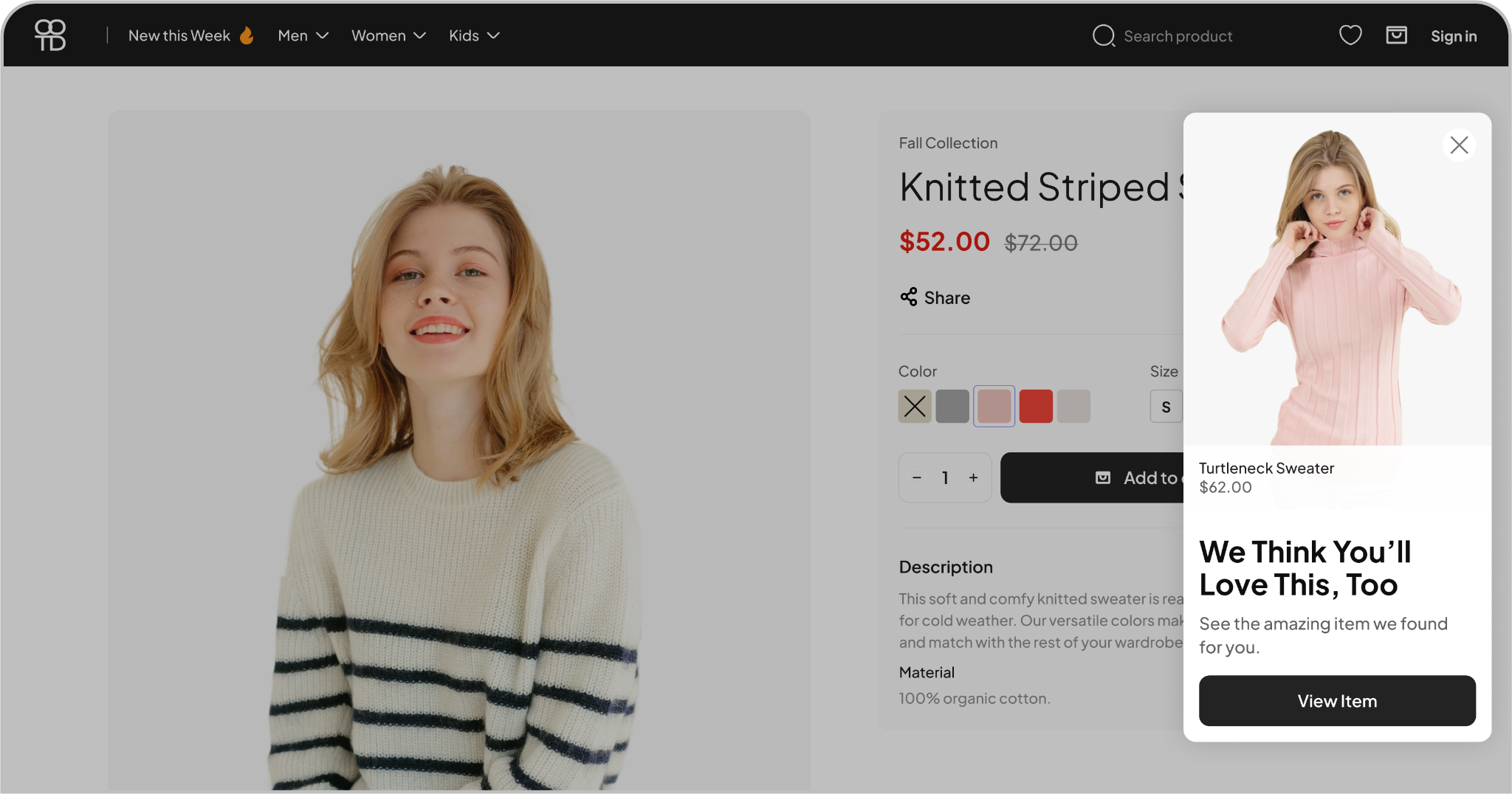
The following image shows an example of a Contextual Commerce discovery campaign that recommends other products to the shopper based on their real-time digital behavior.
How it works
- Test group: Eligible to receive campaigns.
- Control group: Experiences your site without campaigns.
By comparing these two groups, we can prove exactly how much extra revenue Contextual Commerce generates. We call this method attribution. To learn more, refer to the Attribution article.
The decision engine is the AI and machine learning technology that continuously analyzes real-time shopper behavior like clicks and scrolls. This data is used to predict the perfect moment to intervene and encourage a purchase. By closely monitoring how shoppers interact with the site and campaigns, the decision engine learns which strategies are most effective, allowing it to constantly refine its approach.
The Contextual Commerce decision engine uses machine learning to:
- Ingest and analyze hundreds of behavioral data points per second for every session
- Compare data to 20B+ optimized sessions to identify conversion opportunities
- Intervene with targeted product spotlights and contextualization at the optimal moment to convert
- Integrate results into analytics tools (GA4 and Adobe) to easily measure ROI
To learn more, refer to this article on Contextual Commerce AI.
Benefits for retailers
Contextual Commerce helps retailers:
- Achieve a higher conversion rate and prove sales lift during the initial Proof of Value (PoV) trial period
- Enhance engagement and foster loyalty over time
- Minimize the internal capacity required to manage technology through the Bazaarvoice white-glove service offering
- Provide tailored experiences without needing shoppers' PII
Benefits for shoppers
For shoppers, Contextual Commerce:
- Enhances the on-site experience with personalized recommendations, useful information, and accelerated product discovery
- Protects privacy since PII is not required to provide a customized experience
- Connects shoppers to brands and merchants that appeal to their shopping preferences
Ideal clients
Contextual Commerce is a great fit if your store has steady website traffic and a significant number of anonymous visitors. If you want to increase conversion rates and basket sizes through real-time cross-selling, Contextual Commerce is built for you. It delivers the right message at the right time in your customers shopping journey, making it easier for them to discover new items and confidently complete their purchases.
Next steps
The project officially begins with a joint kick-off meeting between your team and Bazaarvoice. Following that, there is a five-week installation timeline:

- Week one: Your team completes the BV Loader expansion and creates group assignments. Simultaneously, Bazaarvoice initiates the campaign workstream with a UX designer call.
- Week two: Your team pushes the Product Catalog (through SFTP) and signs off on the visual campaign design mockups. Bazaarvoice ingests the group assignments.
- Weeks three and four: Your team's primary focus is technical installation and QA. In parallel, Bazaarvoice handles campaign creation, configures restricted states, and performs uneven split A/B tests data validation.
- Week five: Bazaarvoice provides a preview URL, so your team can see exactly how the campaigns will look and behave on your site. After your team reviews this environment and provides final sign-off, it triggers the PoV launch.
The following contributors are needed from your team for the tasks listed:
- Technical implementation (front-end developers or engineers)
- UX/UI approvals (designers or product managers)
- Analytics integration (data analysts or data engineers)