Alerts help you to respond to critical content as soon as it's flagged. Instead of manually searching for negative feedback, you can receive real-time emails when reviews mention specific phrases like "defective" or "safety concern".
How to access the alerts dashboard (two ways)
There are two ways to view and manage your existing alerts:
- From the List View: Select the ellipses icon (...) in the upper-right corner and select Manage alerts.
- From Portal settings: Select the settings icon
 in the upper-right corner of any page and select Manage alerts.
Create an alert
Alerts Contributor Alerts Administrator
To stay informed about specific consumer feedback, you can create real-time alerts. Recipients will receive an email whenever new content matches your specified alert criteria.
- Sign in to the Bazaarvoice Portal.
- From the top navigation bar select Ratings & Reviews.
- From the List View, select the ellipses icon (...) in the upper-right corner.
- Select Create alert. The Create Ratings & Reviews Alert modal appears:
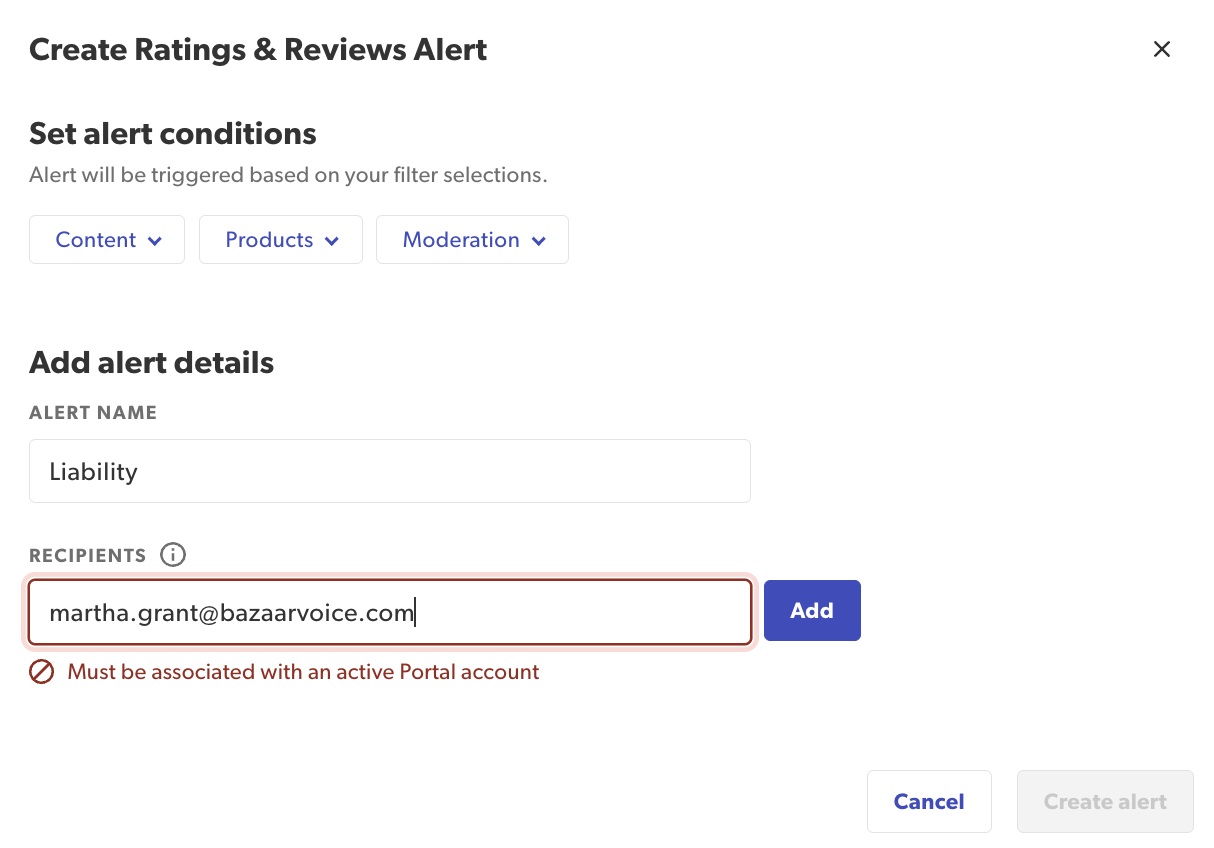
- Set your alert conditions (triggers): Refer to the alert conditions table for more information.
- Name your alert: Use a clear name (for example "[Product Name] | Liability Issues").
- Add Recipients: Enter the email addresses of active Portal users.

- Select Create alert.
 .
.
Alert conditions (triggers)
Alerts are triggered only when all selected conditions are satisfied.
For example, if you set an alert for 1-star ratings and Approved status, the alert will only fire when both trigger conditions are met.
| Trigger condition | Description |
|---|---|
| Content | Ratings
Select one or more ratings: 1 star, 2 stars, 3 stars, 4 stars, or 5 stars. |
| Review type
Select "Rating and text" or "Rating only". |
|
| Locale
Select one or more locales. |
|
|
Text fields (keywords)
Learn more about keyword alerts.
|
|
| Products | Category: Enter category name or ID. |
| Brand: Enter brand name or ID. | |
| Product: Enter product ID or name. | |
| Moderation | Client codes: Applied by your internal moderation team. Select one or more codes. |
| Moderation codes: Applied by the Bazaarvoice moderation team. Select one or more codes. | |
| Moderation status: Select Approved, Rejected, or both. | |
| Post moderation: Triggers an alert when moderation codes are edited on existing content. |
Managing existing alerts
The Manage Alerts page is your central dashboard for viewing and editing active alert notifications. Use the table below to understand the alerts information provided:
|
Column
|
Description
|
|---|---|
| Alert name |
Name of the alert. Select the Alert name link to view or edit the current alert settings. Recipients can view an alert even if they didn't create it.
|
| Created by |
Name of the person who created the alert.
|
| Date created |
Date the alert was created.
|
| Recipients |
The total number of users currently subscribed to this notification.
|
| Alert type |
Type of alert:
|
| Actions |
|
Find alerts
Alert Viewer Alert Contributor Alert Administrator
As an Alerts Administrator you can view any alert. As an Alerts Contributor you can only view alerts you created.
Find alerts using:
- Search field: Enter an alert name in the search field.
- Sort data table: Sort the table by the date the alert was created.
Edit alerts
Alert Contributor Alert Administrator
As an Alerts Administrator you can edit any alert. As an Alerts Contributor you can only edit alerts you created.
To edit alert details:
- In the Manage alerts table, select the Alert name you want to modify.
-
In the modal that appears, update the filters, name, or recipients as needed.
- Select Save.
Delete alerts
Alert Contributor
Alert Administrator
As an Alerts Administrator you can delete any alert. As an Alerts Contributor you can only delete alerts you created.
To delete an alert:
- In the Actions column of the table, select the ellipses icon (...).
- Select Delete alert in the row containing the alert you want to delete.
Stop receiving alerts (unsubscribe)
Alert Viewer Alert Contributor Alert Administrator
To stop receiving alert emails:
- In the Actions column of the table, select the ellipses icon (...).
- Select Stop receiving alert in the row containing the alert you want to stop receiving notifications for.
- Select Remove.
Post-moderation alerts firing rules
Enable this trigger to receive notifications when a moderation code is updated on content that has already been moderated. This is useful for tracking:
- Manual overrides: When a teammate manually changes a code in the Portal.
- Re-moderation: When a review is flagged with
[REMOD]for a second look. - User edits: When a consumer updates their review, triggering a new moderation check.
To reduce 'alert noise,' remove the Post-moderation filter; this ensures you're only notified about new content rather than updates to old reviews.
Best practices: Avoiding "Alert Fatigue"
- Audit monthly: Delete alerts for discontinued products or resolved campaigns.
- Be specific: Use phrases like "battery exploded" instead of just "battery" to keep notifications relevant.
- Consistent naming: Use a format like
[Brand] | [Topic] | [Frequency]to make your alerts table easier to scan.
Get started: Recommended alerts
If you're new to alerts, we recommend setting up these three essential notifications:
- Liability concerns: Filter for the LI code to notify Legal or Safety teams immediately.
- Customer service: Filter for CS or SI codes to catch service issues that require a brand response.
- Quality concerns: Set an alert for 1-star ratings on your top-priority products to identify manufacturing trends.